Act I
The paintbrush struck the polished floor before anyone understood what was happening.
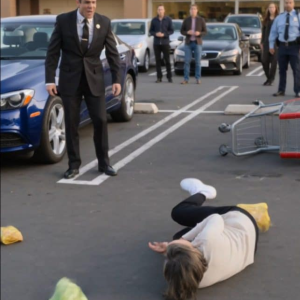
It slid beneath a champagne table, spinning through the reflections of Manhattan’s skyline as Adrian Vale drove his shoulder into the man holding it. The impact sent the stranger backward, his shoes losing traction on the wood before his body crashed beside a display of glossy auction catalogues.
Pages burst into the air.
A woman near the windows gasped. One of the servers nearly dropped a silver tray. Around them, collectors and critics froze beneath the white gallery lights, their conversations dying one by one.
Adrian straightened his black suit and adjusted the red silk scarf at his throat.
He looked immaculate.
The man on the floor did not.
His brown hair was untidy, his old shirt carried pale streaks of dried paint, and one sleeve had been repaired with thread that did not quite match. He looked like someone who had entered through the service elevator and taken a wrong turn.
That was all Adrian needed to see.
“Back away from the art, trash.”
The words cut through the penthouse with more force than the shove.
The fallen man drew in a painful breath and pressed one palm against the floor. His face tightened, but he did not plead. He did not apologize. He simply looked toward the brush that had skidded away from him.
That silence seemed to anger Adrian even more.
“People like you paint walls,” he said, loud enough for every guest to hear. “Not masterpieces.”
A few people looked down.
Others looked at Adrian with open disgust.
But no one moved.
That was the strange power of public cruelty. It often stunned decent people before it awakened them.
Adrian mistook their silence for agreement.
He turned toward the enormous abstract painting mounted on the central wall. It was the reason nearly eighty people had gathered in the penthouse that evening—a violent composition of charcoal, rust-red, and luminous gold, rumored to have been privately valued at more than two million dollars.
No artist’s name appeared beside it.
The invitations had been deliberately mysterious. Guests had been told only that a reclusive American painter was preparing to reveal a private collection after nearly fifteen years of silence.
Adrian had spent the entire evening claiming he already knew who the artist was.
He had whispered names of European modernists. He had hinted at secret negotiations. He had allowed younger brokers to believe he had been personally invited by the painter.
In truth, Adrian knew nothing.
But ignorance had never stopped him from performing authority.
He looked down again at the man he had thrown across the room.
“You almost touched it,” Adrian said.
The man finally spoke.
“I was checking the varnish.”
His voice was quiet, roughened by pain.
Adrian laughed.
The sound was polished, effortless, and cruel.
“Of course you were.”
A ripple of discomfort moved through the guests.
Near the private elevator, an elderly critic named Margaret Sloan narrowed her eyes. She had spent forty years studying brushwork, pigments, and provenance. Something about the stranger’s hands had caught her attention.
They were stained in places no house painter’s hands would be stained.
Ultramarine beneath one thumbnail.
A trace of cadmium red along the side of his index finger.
And a thin scar across his right palm, exactly where an artist’s hand might be cut while stretching raw canvas over a wooden frame.
Margaret stepped forward.
Before she could say anything, the private elevator chimed.
The room went silent.
The doors opened, and the penthouse host walked out with two attorneys, the museum director of the Halston Foundation, and a security officer carrying a leather portfolio.
The host took one look at the man on the floor.
Then he looked at Adrian.
Whatever warmth had been in his face vanished.
He did not greet the collectors.
He did not shake Adrian’s hand.
He walked directly past everyone and stopped beside the fallen stranger.
And when he spoke, he did so with the respect normally reserved for royalty.
“Mr. Reed,” he said, offering his hand, “forgive us for being late.”
Adrian’s smile disappeared.
The host helped the injured man to his feet.
Then he turned so the entire penthouse could hear the rest.
“Everyone here came to honor your million-dollar collection.”
For the first time that night, Adrian Vale had nothing to say.
But the name Reed meant far more than he realized.
Act II
Elias Reed had not attended an art party in fourteen years.
There had been interviews he refused, gallery openings he ignored, and private dinners arranged by collectors willing to cross oceans for ten minutes of his time. He had declined them all.
To the public, Elias Reed was barely more than a rumor.
His paintings appeared without warning, usually through small regional galleries or anonymous charitable auctions. They were signed with a single letter—R—and often purchased before critics could determine where they had come from.
Those who owned them rarely sold.
Those who did made fortunes.
The secrecy had created myths.
Some believed Reed was a collective of artists working under one name. Others claimed he was the heir to an old industrial family. One London critic had written that Reed might not exist at all.
Adrian Vale had once called him “the most profitable ghost in American art.”
He had no idea the ghost was standing in front of him.
Elias bent slowly and retrieved his brush.
The penthouse host, Jonathan Mercer, turned toward security.
“Close the elevator.”
The command was calm.
It still made Adrian step backward.
Jonathan Mercer owned the penthouse, but that was not the source of his authority. His family foundation controlled one of the largest private modern-art collections in the United States. Museums borrowed from him. Auction houses courted him. Careers could rise after one invitation to his home.
Adrian had spent three years trying to become one of Mercer’s preferred brokers.
Now Mercer looked at him as though he had tracked mud across a sacred floor.
“What happened?” Jonathan asked.
No one answered immediately.
Then Margaret Sloan spoke.
“He attacked Mr. Reed.”
Her voice carried cleanly across the room.
“He took the brush from his hand, threw him to the floor, and called him trash.”
Adrian’s face tightened.
“It was a misunderstanding.”
Elias looked at him.
That was all.
No anger. No raised voice. No theatrical threat.
Just a steady, wounded stare that stripped the excuse of all its polish.
Adrian tried again.
“He was dressed like maintenance staff. He was standing too close to the painting, and no one had identified him.”
Jonathan’s jaw hardened.
“You assaulted a man because of his shirt?”
“I was protecting the collection.”
“You were protecting your performance.”
The sentence landed harder than a shout.
A few guests lowered their glasses.
Adrian glanced around the room, searching for someone willing to defend him. He found only witnesses.
Elias moved toward the central painting.
The crowd parted instinctively.
Up close, the work looked even more violent. Thick black strokes cut across muted gray. A narrow gold line rose through the center, almost buried beneath darker layers.
Elias lifted the brush.
He touched the handle—not the bristles—to a small area near the lower corner.
“The varnish is lifting here,” he said to Jonathan. “The room is warmer than it was during installation.”
Jonathan immediately turned to the curator.
“Lower the temperature.”
The curator moved without hesitation.
Adrian watched the exchange, his breathing shallow.
There was no question now.
This man understood the painting because he had created it.
Jonathan faced the guests.
“Ladies and gentlemen, this is Elias Reed.”
The room seemed to contract around the name.
Margaret Sloan closed her eyes for half a second, as though confirming a private suspicion.
A young critic near the bar whispered, “My God.”
Jonathan continued.
“Tonight’s collection represents sixteen years of work. Twelve paintings have already been committed to museums and public institutions. The remaining pieces were to be offered privately, with a portion of all proceeds funding arts programs in underserved communities.”
Adrian stared at Elias’s worn shirt.
It suddenly looked different.
Not cheap.
Used.
There were paint marks on the cuff because Elias had been working hours earlier. He had arrived before the party to examine the installation himself, entering through the service elevator to avoid attention.
He had not dressed like hired help.
He had dressed like an artist.
The distinction had existed only in Adrian’s mind.
Jonathan stepped closer to Elias.
“Do you need a doctor?”
“I need a few minutes.”
“Of course.”
Elias walked toward the floor-to-ceiling windows.
Below him, Manhattan burned with white and red light. His reflection floated faintly in the glass: an ordinary man in an old shirt, surrounded by people who had paid thousands of dollars to stand near his work.
He had expected discomfort that night.
He had expected questions.
He had not expected the sound of catalogues striking the floor to drag him back twenty-three years.
Back to another polished room.
Back to another wealthy man telling him where people like him belonged.
And back to the reason Elias Reed had disappeared in the first place.
Act III
Elias had been sixteen when his mother lost her job cleaning the offices of the Vale-Rothman Gallery.
The gallery had occupied three floors in SoHo and represented some of the most valuable American painters of the late twentieth century. Elias’s mother, Rosa, cleaned it after midnight.
Sometimes she brought him with her.
While she emptied bins and polished glass, Elias sat on the floor with discarded charcoal and drew on the backs of shipping invoices. He studied paintings no teacher had ever shown him. He learned composition from silence and color from rooms he was not supposed to enter.
One winter night, the gallery’s founder, Charles Vale, found him sketching.
Charles did not throw him out.
He watched.
Then he asked Elias to return the next evening.
For nearly a year, Charles quietly gave him damaged canvases, old brushes, and books from the gallery library. He told Elias he had something that could not be purchased.
An eye that recognized pain.
Charles intended to sponsor his education.
He never got the chance.
He died suddenly after a private dinner with investors.
His son inherited the gallery.
Adrian Vale was twenty-three at the time.
Within a week, Rosa Reed was accused of stealing a silver sculpture from storage.
The police found it in her locker.
She swore she had never seen it before.
No one believed her.
Adrian dismissed her publicly, withheld her final paycheck, and told security to escort her and Elias through the front entrance so every employee could watch.
Elias remembered Adrian’s words.
“People like you should be grateful we let you inside.”
Rosa was never charged. The sculpture’s insurance records contained irregularities, and the gallery quietly withdrew its complaint.
But the accusation followed her.
She could not find steady work. Their landlord changed the locks after three missed payments. By the time Elias turned seventeen, he and his mother were sleeping in the back room of a church-run food pantry in Queens.
He painted at night.
Not because he believed it would save them.
Because it was the only place his anger could go without destroying him.
Years later, Jonathan Mercer discovered one of those early paintings in a charity sale. He purchased it for four hundred dollars, then spent months trying to find the artist.
When he finally met Elias, he offered representation.
Elias refused.
He would sell paintings, but not himself. No interviews. No photographs. No cultivated mystery. He wanted the work to travel farther than his face ever could.
Jonathan agreed.
Their arrangement held for sixteen years.
Until Rosa became ill.
The collection in the penthouse had been created during the final decade of her life. Every canvas contained something from their past: the yellow light of the church pantry, the green tile of a Queens hospital corridor, the silver gleam of the sculpture that had destroyed her reputation.
The central painting was called The Door They Closed.
Elias had painted it after his mother’s funeral.
Jonathan knew the story.
Adrian did not.
He stood across the penthouse, whispering urgently to one of his assistants.
“This can still be contained,” he said. “No recording. No police. We apologize, make a donation, and move forward.”
His assistant stared at him.
“You assaulted Elias Reed.”
“I made a mistake.”
“No,” she said. “You made a decision.”
She removed the Vale Art Group badge from her jacket and placed it on a table.
Adrian watched her walk away.
Then the museum director approached Jonathan with the leather portfolio.
“We should review the documents privately.”
Elias turned from the windows.
“No,” he said. “Not privately.”
Jonathan studied him.
Elias looked toward Adrian.
“For twenty-three years, everything involving that family happened behind closed doors. Tonight, leave them open.”
The attorneys exchanged a glance.
Jonathan nodded.
The portfolio was placed on the central table.
Inside were copies of old employment records, insurance reports, handwritten letters, and a sealed statement from Charles Vale’s former accountant.
Adrian’s face changed before a single page was read.
Elias noticed.
So did Margaret Sloan.
Jonathan removed the first document.
“This collection was not the only reason we invited you tonight,” he said.
A low murmur passed through the guests.
Jonathan unfolded a letter written on faded gallery stationery.
It had been signed by Adrian’s father three days before his death.
And it named Elias Reed.
Act IV
The letter was short.
Charles Vale wrote that he had discovered an unusually gifted young artist named Elias Reed and intended to establish a scholarship in his name. He also stated that several drawings by Elias had been temporarily stored in the gallery’s private archive.
Those drawings had disappeared after Charles died.
For years, Elias assumed they had been thrown away.
They had not.
Jonathan placed three auction records beside the letter.
The earliest was dated nineteen years earlier. It listed an untitled charcoal work attributed to “an anonymous American modernist.” The second and third showed similar pieces, each sold through shell consignors connected to Vale-Rothman.
Margaret moved closer.
“I remember these,” she said. “The line work was unmistakable. Critics thought they were lost studies by Daniel Hurst.”
“They were Elias’s,” Jonathan said.
Adrian laughed too quickly.
“That proves nothing.”
One of the attorneys opened another folder.
“It proves enough to begin.”
The old accountant’s statement described how Elias’s drawings had been removed from storage and relabeled after Charles’s death. The profits had been used to cover losses hidden in the gallery’s books.
The silver sculpture placed in Rosa Reed’s locker had served a similar purpose.
It had already been damaged during unauthorized transport. By reporting it stolen, the gallery could file an insurance claim and blame an employee with no resources to fight back.
Rosa had not been a thief.
She had been evidence disposal.
The room reacted with a sound deeper than a gasp.
Adrian’s eyes darted toward the elevator.
The security officer stepped in front of it.
“You cannot hold me here,” Adrian said.
“No one is holding you,” Jonathan replied. “But you will not leave with any document belonging to this investigation.”
“This is defamation.”
“The originals were authenticated this morning.”
Adrian turned to Elias.
“You planned this.”
Elias’s expression remained still.
“I planned to show my mother’s name beside the paintings she inspired.”
He looked at the scattered catalogues still lying near the floor.
“You supplied the rest.”
Adrian’s control began to break.
He pointed toward the artwork.
“You think these people care about your mother? They care because your paintings are expensive. Without collectors, you are still a man in a dirty shirt.”
The cruelty returned because it was the only weapon he knew.
But it no longer had an audience willing to be impressed.
Margaret Sloan removed her glasses.
“You have misunderstood art your entire life,” she said. “Price follows meaning. It does not create it.”
The young critic near the bar raised his phone, not to record, but to cancel a scheduled meeting.
Another collector whispered to his advisor.
Within minutes, two museums suspended pending transactions with Vale Art Group. A private buyer withdrew from a seven-figure acquisition. The Halston Foundation announced it would conduct a provenance review of every work brokered by Adrian’s firm.
No one shouted.
No one needed to.
His empire began collapsing in murmurs.
Jonathan turned toward the security officer.
“The police have been notified about the assault. The financial evidence will be delivered separately.”
Adrian stared at Elias.
“You would destroy my father’s name over something that happened decades ago?”
Elias finally stepped closer.
Not aggressively.
Just enough for Adrian to see that there was no fear left in him.
“Your father tried to help me.”
The words struck Adrian with visible force.
“This was not his legacy,” Elias continued. “It was yours.”
Adrian opened his mouth.
Nothing came out.
Elias lifted the recovered paintbrush and placed it on the table beside Charles Vale’s letter.
“My mother spent the last years of her life believing some people still thought she was guilty,” he said. “Tomorrow, the correction will be public.”
For the first time, his voice wavered.
Only slightly.
“That is all I ever wanted.”
Jonathan nodded to the museum director.
She removed a final sheet from the portfolio.
It was not an accusation.
It was an announcement.
The central painting, The Door They Closed, had been acquired by the Museum of American Memory on one condition set by the artist.
It would never hang under Elias Reed’s name alone.
The wall label would read:
Elias Reed, in memory of Rosa Reed, who cleaned galleries at night so her son could learn to see.
Several guests lowered their eyes.
Margaret openly wept.
Adrian stood beneath the white lights, surrounded by wealth, influence, and culture.
Yet never in his life had he looked smaller.
Then Elias revealed what would happen to the rest of the collection.
Act V
The paintings were expected to sell for more than eighteen million dollars.
Elias donated every one of them.
Not to a single institution, and not to collectors who would hide them in climate-controlled rooms.
The collection was divided among public museums, community colleges, libraries, and arts centers in neighborhoods where children often encountered security guards before they encountered original art.
The sale proceeds from limited exhibition rights would fund the Rosa Reed Fellowship.
It would pay tuition, housing, supplies, and medical support for young artists caring for low-income parents.
There was one additional condition.
No applicant would be required to submit a professional résumé, obtain a recommendation from an established gallery, or attend a private interview in expensive clothing.
Talent would be judged by the work.
Nothing else.
Jonathan read the terms aloud.
When he finished, the penthouse remained silent.
It was not the shocked silence that had followed Adrian’s assault.
It was reverence.
Elias looked around the room.
An hour earlier, many of these people would have walked past him without seeing him. Some still seemed ashamed of that truth.
He did not humiliate them for it.
He simply asked them to remember.
“Art does not begin when wealthy people approve of it,” he said. “It begins wherever someone is trying to survive without losing the part of themselves that still feels.”
His gaze moved briefly toward Adrian.
“My mother never painted. But every painting in this room exists because she kept going.”
The applause began near the windows.
Margaret started it.
Then the museum director joined her. Then the servers. Then the critics, collectors, attorneys, and guests who had stood frozen while Elias lay on the floor.
Soon the sound filled the penthouse.
Elias did not smile.
Not yet.
He turned toward the central painting.
For years, he had imagined this moment as revenge. He had pictured Adrian exposed, the old files opened, his mother’s name cleared.
But revenge felt smaller than he expected.
The real victory was not seeing Adrian afraid.
It was seeing Rosa’s name placed where no one could remove it.
The police arrived quietly.
Adrian was escorted toward the private elevator as guests stepped away from him. The same crowd he had once commanded now avoided his eyes.
At the doors, he stopped.
His red scarf hung crooked. His face had lost its practiced confidence. He looked toward Elias as though searching for one final argument, one loophole, one version of reality in which status could still protect him.
“Reed…?”
The name broke in his throat.
Elias met his stare.
He did not insult him.
He did not step forward.
He did not need to.
The elevator doors closed.
Three months later, Rosa Reed’s employment record was formally corrected. The accusation of theft was declared unsupported and connected to a fraudulent insurance scheme under federal investigation.
Vale Art Group dissolved before the end of the year.
Several employees cooperated with authorities. Stolen and misattributed works were returned to artists and families who had long believed them lost.
Adrian pleaded guilty to assault and later faced additional financial charges.
But his downfall became a footnote.
The fellowship became the story.
In its first year, the Rosa Reed Fellowship supported twenty-two young artists. One was a hospital custodian who painted after midnight. Another was a grocery clerk raising two younger siblings. A third was a seventeen-year-old girl who submitted charcoal drawings made on the backs of discarded shipping boxes.
Elias personally reviewed every portfolio.
He never asked what the applicants wore.
Years later, visitors to the Museum of American Memory would still stop in front of The Door They Closed.
From a distance, the painting seemed almost entirely dark.
But when viewers stepped closer, they could see the narrow line of gold pushing upward through the black paint.
It did not erase the darkness.
It survived it.
Beside the canvas, Rosa Reed’s name appeared in letters as large as her son’s.
And beneath it was a single sentence chosen by Elias:
She was never allowed to enter through the front door, so she raised a son whose work would hang on every wall inside.